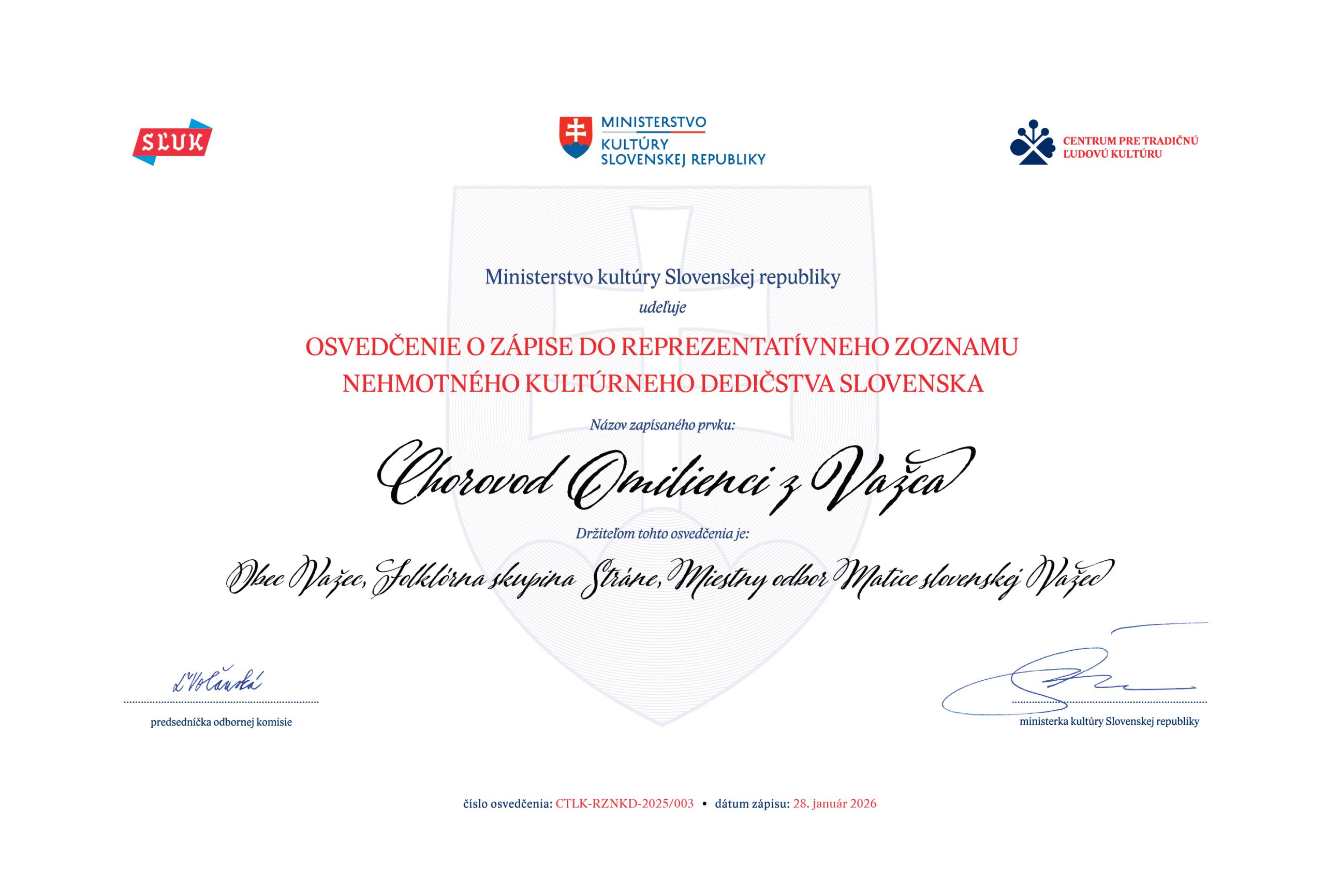
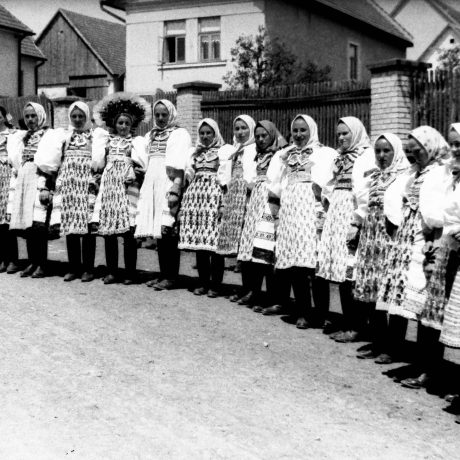
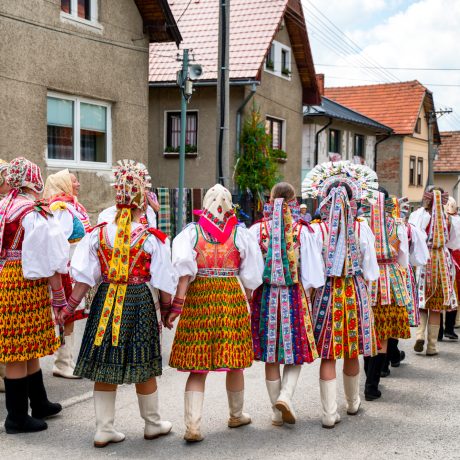
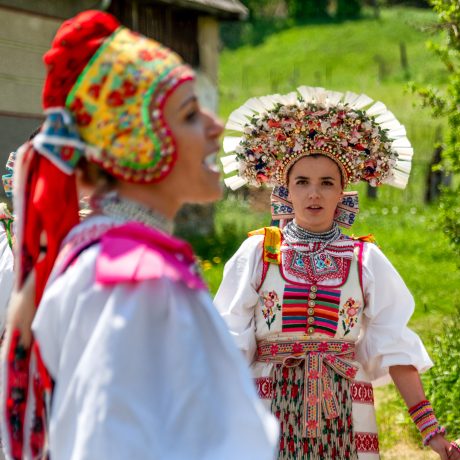
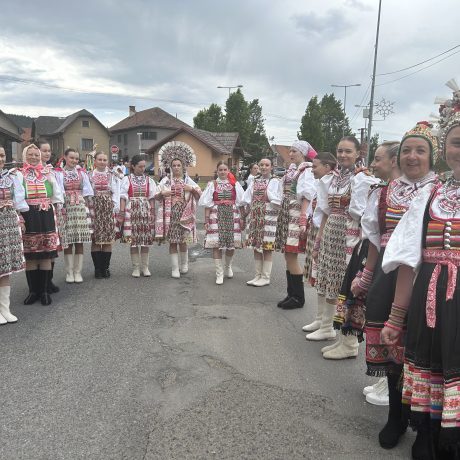
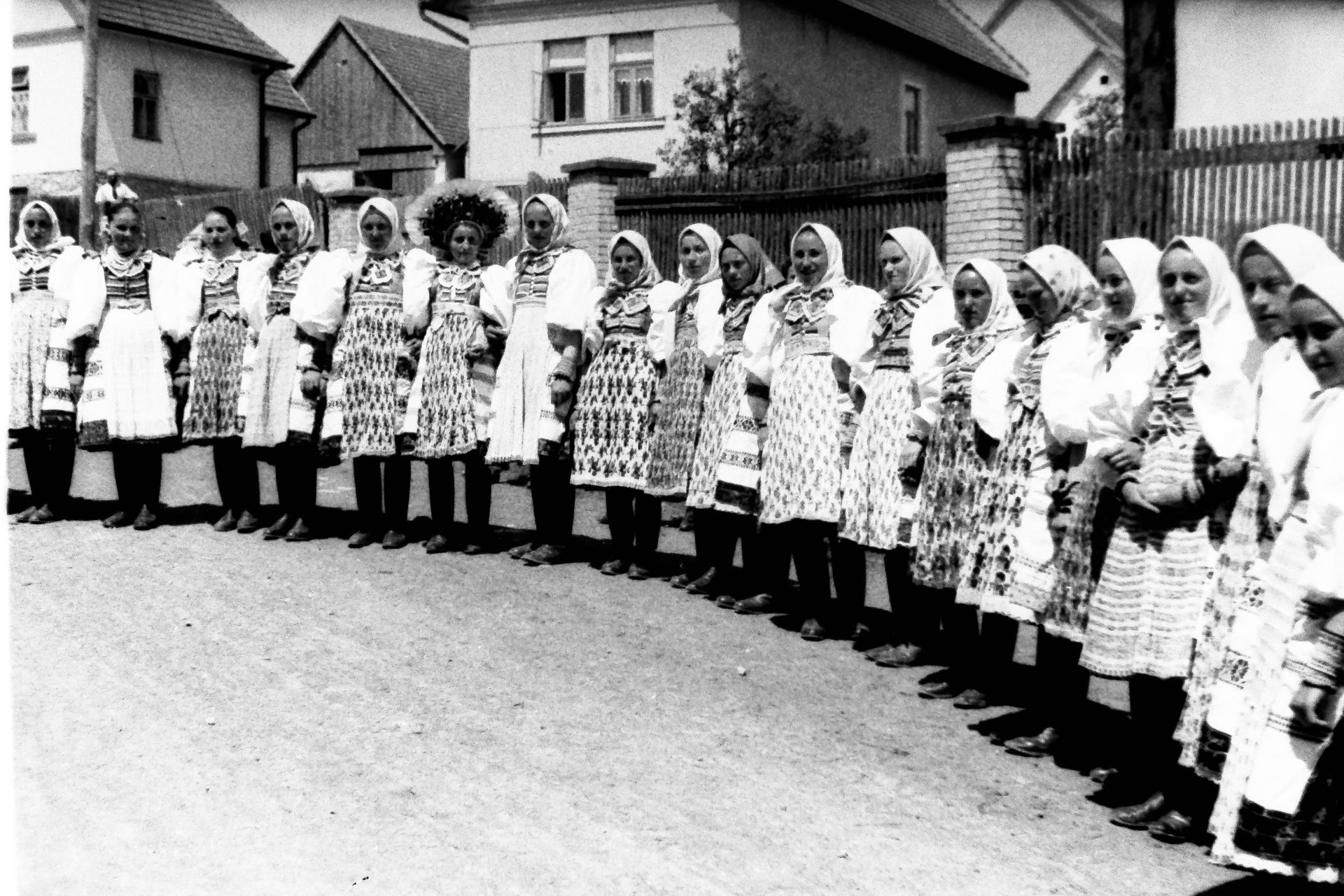
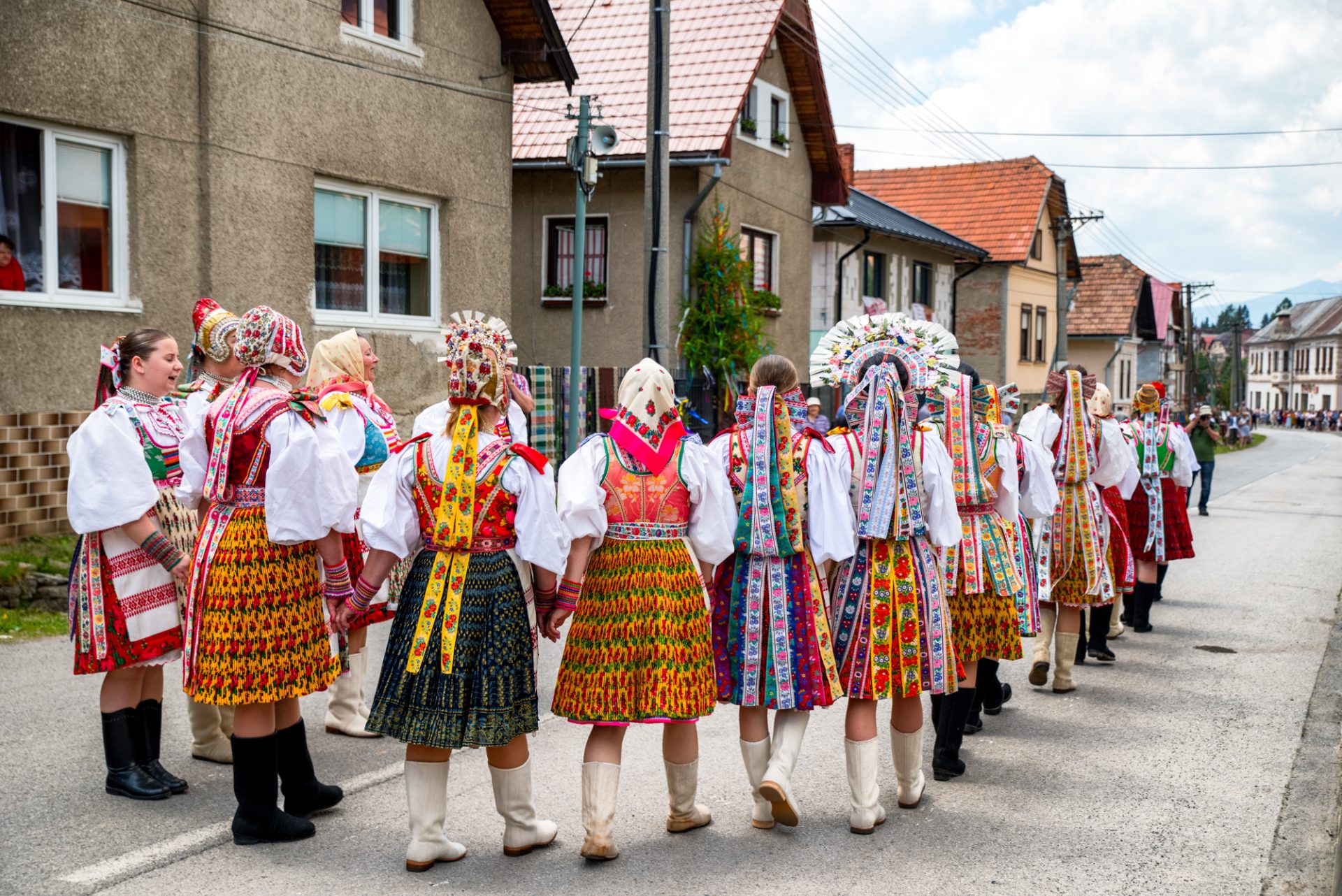
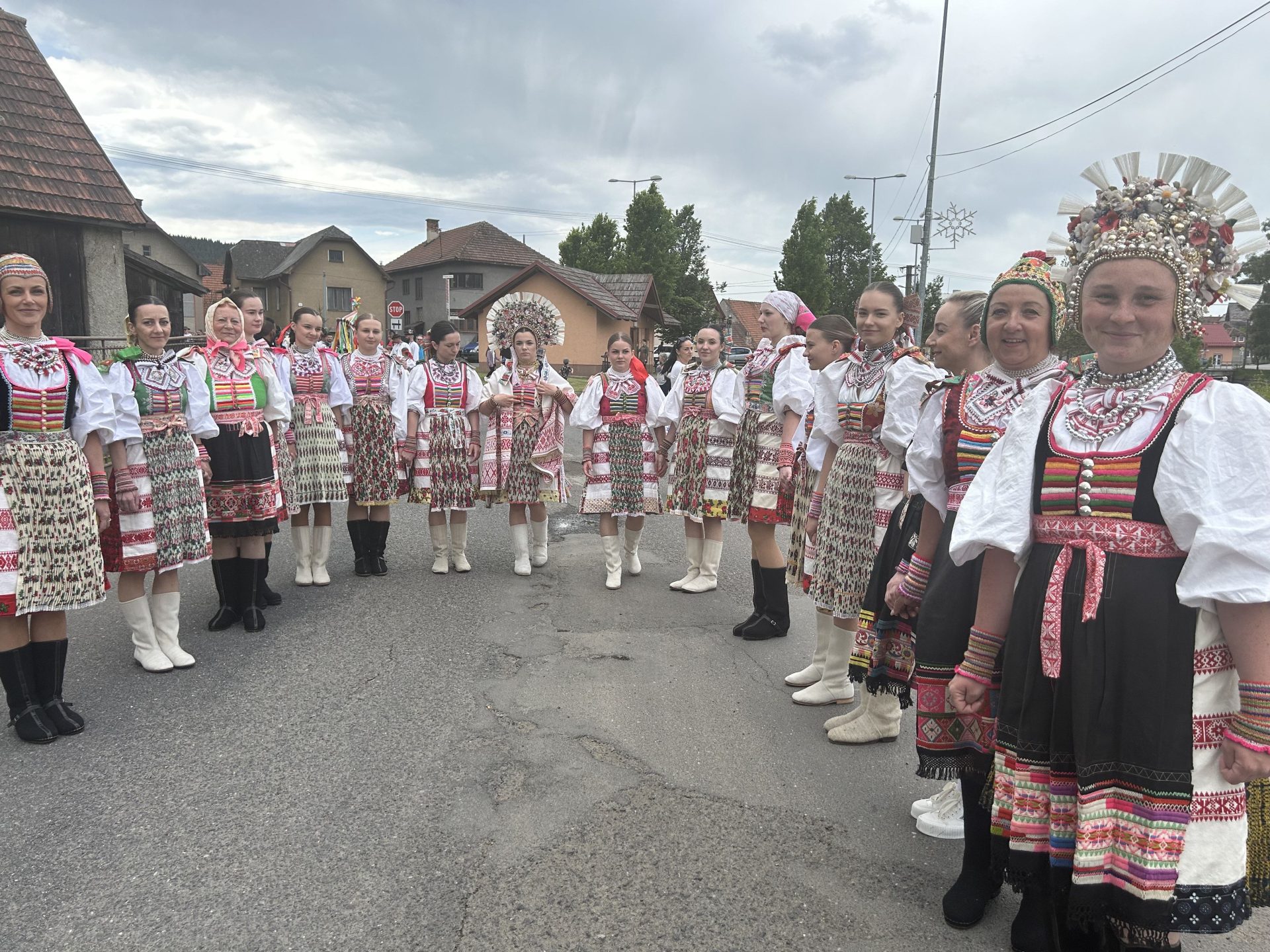
In the current nationwide context, the Omilienci khorovod (“chorovod” in Slovak) from Važec (Liptovský Mikuláš district) represents a still-living, deeply historically rooted ritual procession combining both song and dance. It is associated with the period of Pentecost, the Christian holiday of the Descent of the Holy Spirit (known as Whitsun, or locally as Letnice or Rusadlá), and historically traces back to pre-Christian festivities such as Pascha rosarum. In addition to the cult of ancestors, these celebrations were primarily linked to economic prosperity, including water, greenery, livestock, and, grain.
The khorovod was traditionally performed every year on Whit Monday exclusively by unmarried girls, or by married young women who had not yet borne a child, after the end of the church service. Formed into a horseshoe shape, the participants moved through the village while singing. The formation consisted of 20 to 30 girls and young women, holding white scarves. It was led by two lead singers walking independently a few steps ahead of the others. The lead singer on the right began to sing while facing the group; she then stepped forward, and the others followed, singing and moving in a step pattern at a slow to moderate pace. The left side continued in the same manner, so that the khorovod alternately moved in a U-shaped formation. The chorus is functionally tied to the song “Omilienci choďia.” After the traditional solo singing of the first verse of each stanza, polyphonic singing by all participants follows. As a rule, the last bride served as the lead singer. In the past, two khorovods were performed in Važec, from the lower and upper parts of the village, meeting in the centre.
Since the 1930s, the khorovod has also included members of folklore groups, married women from the local community, and girls before reaching sexual maturity. As a result, the earlier ceremonial and symbolic function tied to the specific status of the female participants has gradually disappeared. A further change occurred after 1948, when Whit Monday became a working day and the performance shifted to Sunday. The route of the khorovod also changed, beginning on the main street near the cemetery and ending at the Evangelical church. Despite these changes, the form and melody have been preserved.
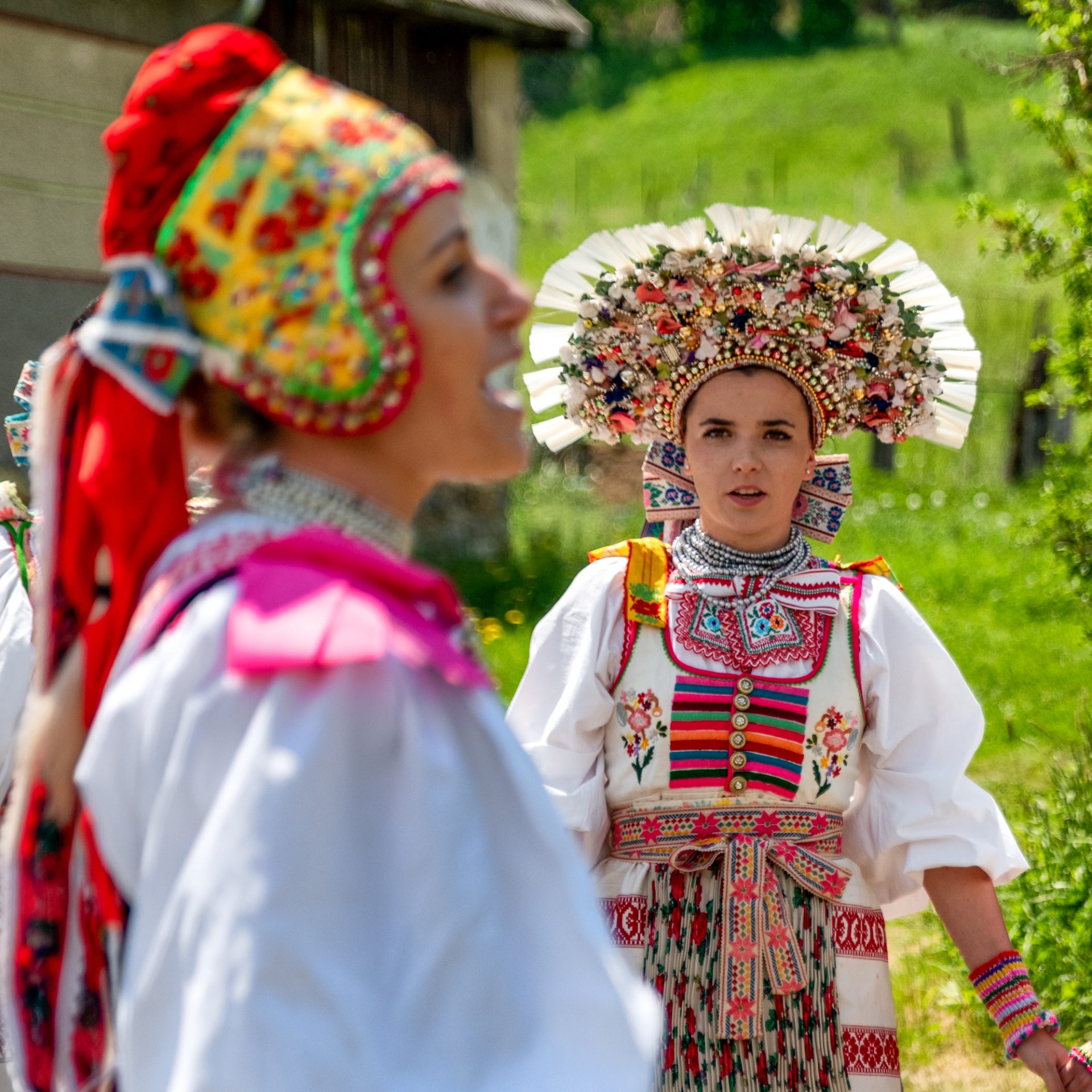
The khorovod is syncretic in nature, combining a stable spatial arrangement, movement, singing, festive clothing, and a defined hierarchy among female participants. Knowledge of the khorovod is preserved by performers, pedagogues, and choreographers of folklore groups through research, educational, and presentation activities. The transmission of this knowledge to younger generations takes place through oral tradition and the development of practical skills within folklore groups, ensembles, and associations that have operated in Važec. Today, the tradition is successfully continued by the DFS Podkrivánček (since 2004), and the Folklore Association Stráne Važec (since 2008). and co-organised by the Municipality of Važec and the local branch of Matica slovenská.
Proposal by
Year of Inscription
Certificate number

Važec Municipality, Folklore Group Stráne, Local Branch of Matica Slovenská
2026
CTLK-RZNKD-2025/003